

Doctor 1: You mean there was no deep fat? No steak or cream pies or hot fudge?
Doctor 2: Those were thought to be unhealthy. Precisely the opposite of what we now know to be true.
—From Sleeper, a comedy set in the year 2173
This is Part 3 of a short series on money. We started here with a look at what dollars are. There we uncovered the most basic fact about dollars, obvious yet never ever acknowledged:
• You can’t make dollars. Only the government does that.
Totally obvious, right? Can you print money? No. Can the government? Yes. In fact, every dollar you own came from the government. If the government never made dollars, you would have none, since no dollars would ever exist.
Let that sink in. It’s both obvious and hard to believe, because the implications change black into white, reverse what you think — and more, reverse what those who run government want you to think.
The lie: The federal government is spending your money, “your tax dollars.”
The truth: All of your dollars come from the U.S. government. The deceptively named “deficit” is no deficit at all. It’s a surplus. It’s money for you.
Back to the Start
Let’s go back to the start of a country like ours, a country that makes its own money. This imagined government is new, so no one who lives there has dollars.
How to fix that? Easy. The government spends; it buys things. Dollars go out to the public, goods and services come back, and people have money to purchase things for themselves.
So is government spending a debt? Of course it’s not. Government spending is a trade; it puts something out, gets something back, and we get dollars to use. Good for us! The economy now works.
Every Government Dollar Goes To Somebody’s Pocket
Here’s the truth: Every “deficit” dollar is not a debt — it’s a dollar we own. Here’s a picture of the U.S. economy from 1952 to 2020:
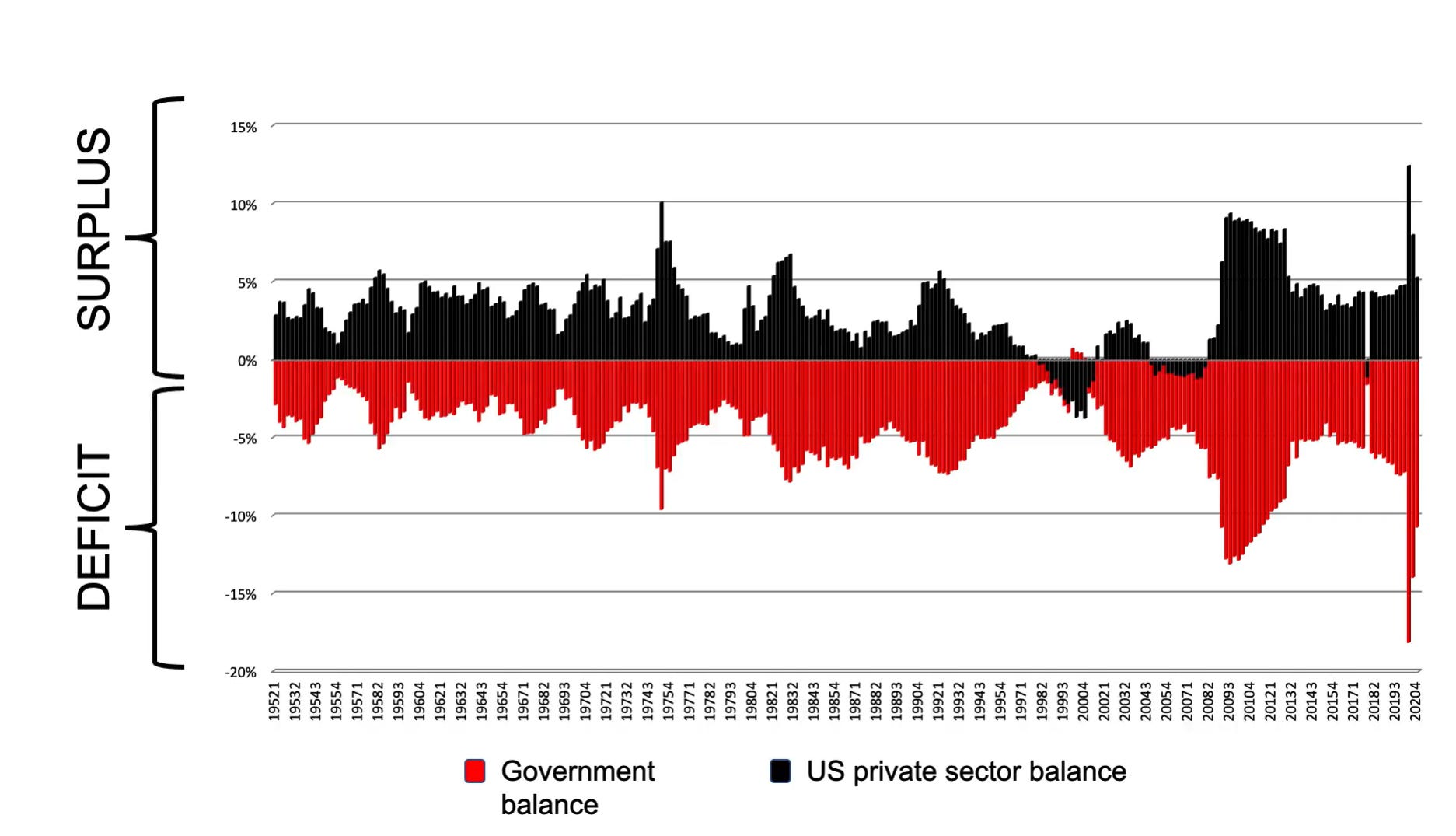
The bottom-half lines show the deceptively-named “deficit.” Again, this is not money owed; it’s just money being spent. The top-half lines show money in circulation — new money we have thanks to new government purchases.
• The “deficit” isn’t a debt; it’s a gift to consumers.
To see the full story, watch this video. It’s short and clear.
So What’s the Bond Market?
If the “deficit” isn’t a debt, then what’s the bond market? That’s an excellent question. The bond market’s totally optional, not needed at all. It’s another gift to consumers, mainly the rich. It’s just a place to park money.
Curious? Stay tuned for Part 4. You’re in for a treat.
Looks like we’re batting 1000:

Social Security is a fine example. 70 or so million checks (direct deposits in many cases) go out, and what's done with that money: Goods and services as that money flows through the economy as it continues to circulate benefiting multitudes.
Right now I'm thinking about the 'work' a dollar can do. As a practical illustration, think of the purchase of energy for your living quarters. In general, saying you get less light and hot water for your buck is not controversial. Since this state of personal energy procurement has held true over the course of my 73 years, one can conclude that our currency is less powerful as power depicts work per unit of time.
Where our money goes should be the central campaign issue of this upcoming midterm election. Because the distribution of our money is grotesquely skewed to a very few of us. This writer and and you are not of that few.
What do those few do with the money? Well one thing is for sure, it goes to work taking your money. And not only your money, but the assets you worked to secure with your money.
I can predict where part IV is going: we are getting screwed, the deficit and the bonds that supposedly finance it are elegant ruses for the few to siphon our dollars.