

This is Part 4 of a brief series on the U.S. dollar: What they are, where they come from, and why people are so confused about debts and deficits. Today we’ll reveal what the federal bond market is.
Other pieces in this series:
• Part 1 is about the dollar itself: “Why ‘Entitlement’ Cuts May Succeed”
• Part 2 explains why taxes are levied: “Why Governments Tax: A List”
• Part 3 discusses the ‘deficit’: “What Is This ‘Deficit’ We Hear So Much About?”
And Part 5, yet to come, will answer the question: If all of that’s true, then what is the national debt?
Onward. What is this “bond market” we’re told to so worry about?
Dollars: Our Story So Far
Let’s start with what we know from before:
Rule 1. Only our government makes dollars.
You can’t make dollars, not real ones, not ones you can spend. Every dollar in your pocket, and every dollar in every account you own, ultimately came from the government. That’s just a fact.
Rule 2. As a result, the government doesn’t need taxes in order to spend. Period. End of.
There are no ‘buts’ or ‘ands’ to this. Everyone you see on TV knows this is true. Every person who says “we don’t want the government printing money” acknowledges that indeed, the government, broadly considered, prints money. Again, there’s no other source of dollars but the U.S. government. (Yes, banks create dollars by lending and the Federal Reserve issues bills, but only by law, by government authorization, and under strict rules.)
Rule 3. Because government gets dollars from itself, the “deficit” isn’t a debt at all — it’s a gift.
If the country were started from scratch and dollars were king, but in its wisdom the government spent nothing at all, then hell, we’d all be broke. Government spending puts dollars in circulation. Period. End of. The so-called “deficit,” that so-scary word, is just additional dollars in circulation. And nothing more. The word “deficit” is a construct. It’s deceptive labeling. For how the construct is constructed, skip down to here.
So if government makes its own money, what’s the bond market? Isn’t it government borrowing? Inherently, no.
Rule 4. The selling of U.S. Treasuries is entirely a choice.
This follows from what’s above. If the government doesn’t have to borrow in order to spend, the Treasuries market must serve other goals. Let’s take a look.
What Is The U.S. Bond Market Really?
The “bond market” for these purposes means the market for U.S. Treasuries, called bills, notes or bonds depending on when they “mature”, when they can be redeemed.
Treasury bonds look like a loan — the government gets dollars from us, just like companies do, and pays interest till the bonds are redeemed at maturity. But because our government can make dollars out of thin air, it doesn’t actually need yours. So why does the bond market exist? It has several goals.
Bond Market Goal 1: A Way to Manage the Money Supply
Economist Stephanie Kelton explains this point in a piece in which she counters a statement Paul Krugman made about the relationship between deficits and interest rates. The details of that discussion aren’t important here. But in the piece she says:
The government [coordinates] its deficit spending with bond sales, thereby doing a reserve drain (selling bonds) along with a reserve add (deficit spending), so that the newly injected reserves are quickly transformed into newly added Treasuries. The bond sales are done to coordinate the impact so that the government’s fiscal operations don’t leave the banking system with a larger monetary base….
Kelton elsewhere repeats this:
[T]he sale of government bonds by the sovereign [is] something quite different from borrowing: bond sales are part of monetary policy and help the central bank to manage interest rates. Government’s [sic] don’t need to borrow their own currency!
Obviously true, right? Deficits inject money into the system. Bond sales take money out, park that money in a bank called the U.S. Federal Reserve, and keep it from causing inflation. The interest is your reward for taking the deal.
So that’s Goal One of the Treasuries market — manage the money supply.
Bond Market Goal 2: Provide a Safe Haven for Dollars
What’s the second goal of the Treasuries market? If you think hard, you’ll probably guess it. When are Treasuries most bought? Normally, when times look tough and other investments look too risky. Treasuries serve as a risk-free safe haven for money. Gold serves much the same function, though it’s less risk-free.
And since the U.S. government is (up to this moment at least) the king of the world, the dollar is king of money, and U.S. bonds are the safest of all investments. That benefits everyone with dollars to invest. But it benefits most those with the biggest pile. I’ll say it again, the Treasury market’s a gift to those with much cash.
Side Note — Why Are Treasury Prices Down Now?
Why is that not true today — why are Treasury prices falling even though global risks seem especially high? These are not normal times, and gold’s not immune.
Gold hasn't been immune [from price drops]. Data suggests bullion and gold ETFs such as $GLD experienced selling pressure even as headlines worsened. The reason is pragmatic: margin calls, rebalancing, and forced liquidity needs push traders to sell highly liquid assets first — and gold and Treasuries are prime candidates. The numbers point to a liquidity-driven dynamic rather than a pure risk-on rotation; in short, investors are prioritizing cash over protection.
This is the last five years of the gold market:
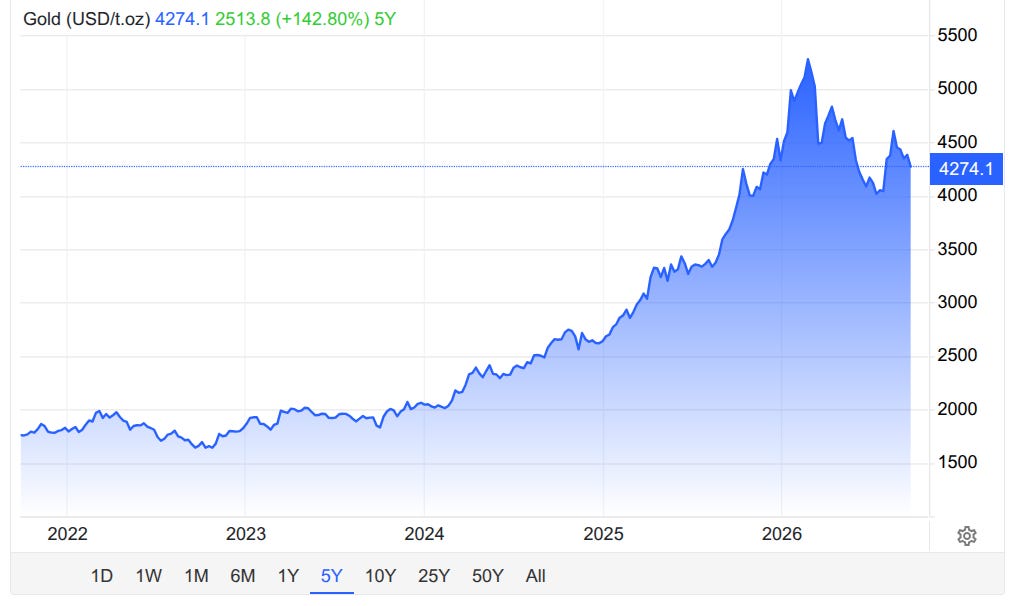
The peak in the chart occurred on February 23, a week before the U.S. attacked Iran. What the outcome of that war will be is obvious to anyone with eyes:
The U.S. will lose its empire, its one-power status. Goodbye to the king.
If the Iran war continues and Gulf petroleum stays scarce, the world could see a real, global, energy-driven depression that lasts for years. That will hurt everything.
End of side note — as you can see, this is a whole other topic.
What Ties Treasury Bonds to Government Spending?
If the creation of Treasury bonds is voluntary — if our government has no need to borrow what it can create — why do people think its bonds are a government debt?
Answer: Because our government passed a series of laws — again, voluntarily — that ties some of its spending to the selling of bonds. This was a choice.
If you care, here’s how those laws work:
The U.S. Constitution requires all government spending to be approved by Congress (Art. I, § 9, cl. 7). Note: Congress can authorize spending without raising revenue. This is a key point.
The Antideficiency Act (31 U.S.C. § 1341) forbids the government from spending money that hasn’t been appropriated. They can spend cash on hand, but only up to what Congress allows. The Act was first passed in 1870 to curb post-Civil War government spending.
This allows unlimited spending, which happens today. Now the constraints:
A law governing the issuance of U.S. Treasury notes — 31 U.S.C. § 5115 — limits the Treasury Department’s ability to literally print money, paper bills. This in turn limits its cash on hand. That law allows the Treasury to issue “United States currency notes,” but caps the total at $300,000,000, a pittance today. In addition, those Treasury notes “may not be held or used for a reserve”. (This is another leftover from the Civil War era, when the Legal Tender Act of 1862 allowed the government to issue paper money not backed by gold, the so-called “greenbacks”. Remember, this is the “gold standard” era. We’re not tied to gold any more.)
If the Treasury cannot print paper money on its own, who can? The Federal Reserve Act, Section 16 grants the Federal Reserve bank the right to do that. That’s why the bills in your pocket say “Federal Reserve Note” and not something like “U.S. Treasury Note.” The Federal Reserve Act was first passed in 1913 under Woodrow Wilson.
Finally, the Federal Reserve Act, Section 14(b) forbids the Fed from financing the government directly. When it runs low on cash, the Treasury Department is required to sell bonds on the open market, bonds that anyone can buy, including the Fed. “[A]ny bonds, notes, or other obligations which are direct obligations of the United States ... may be bought and sold without regard to maturities but only in the open market” (emphasis mine). Without that requirement, the Fed could just hand over cash and the Executive Branch could spend it.
And that, ladies and gents, ties government spending to bonds. A choice, and only a choice. There’s nothing in nature that makes things work this way.
Congress can authorize spending as much as it likes. The Treasury can spend as much cash as it has on hand, up to the limit of Congressional allocations. But when the Treasury runs out of cash, it’s forced to sell bonds.
Which reveals a Goal Three of this complicated construction: It allows the rich who run everything to freely give cash to themselves (looking at you, Raytheon) while still pleading poverty (look, the debt!) when it comes to nice things for you (like railroads, Social Security and good Medicare).
See how that works?
Next Up
Next up, the last in our series, What is the national debt? That will be short, I promise. And when we’re done, you’ll know all you need to know about why you’re not rich.
As Warren Mosler says, government bonds are universal basic income for people with money. Bonds are overwhelmingly held by or on behalf of people with lots of money.
Also, since the US government is a net payer of interest (by a lot), rising interest rates tend to be inflationary rather than deflationary. They add money to the non-government sector (but with real distributional effects that are not great).
It's also worth noting that while banks can and do create bank deposits ("money") under government authority, that money comes along with an encumbrance. You have to pay it back. For every dollar created by private banks through lending, a corresponding dollar of private debt is also created. This is not true of government money creation (spending). What's more, the banks create a private liability (interest) for which they do NOT create the deposits to pay. In order for the economy to actually grow, and for the private debts to be paid, (all else being equal) the government MUST deficit spend to add at least enough money to the system to cover private interest payments over time. Only the government can create unencumbered money.
Lastly, and in regard to the "debt" (that isn't), the "debt ceiling" is another choice made by Congress that has no Constitutional requirement whatsoever. It could be repealed at any time via the same process used to create it (and the sooner the better).
Great work Thomas, much appreciated. I have an entire section of my library dedicated to this subject. I would also (if you're not already) encourage you to read the work of Ellen Brown, it very good and praised by Michael Hudson. One more thing, when you state "...Yes, banks create dollars by lending..." an example is needed, here's one: A mortgage loan of $100,000 becomes a monetary plus on the bank's books.