
There’s a great deal of interest in ArtCraft’s AI-generated clones of Adobe and Microsoft apps these days. We discussed them here — “The Bright Side of the Dark Side of AI” — and there’s been considerable response. Here are some follow-up notes.
Downloading and Using the Apps
To go directly to download instructions and links, click here.
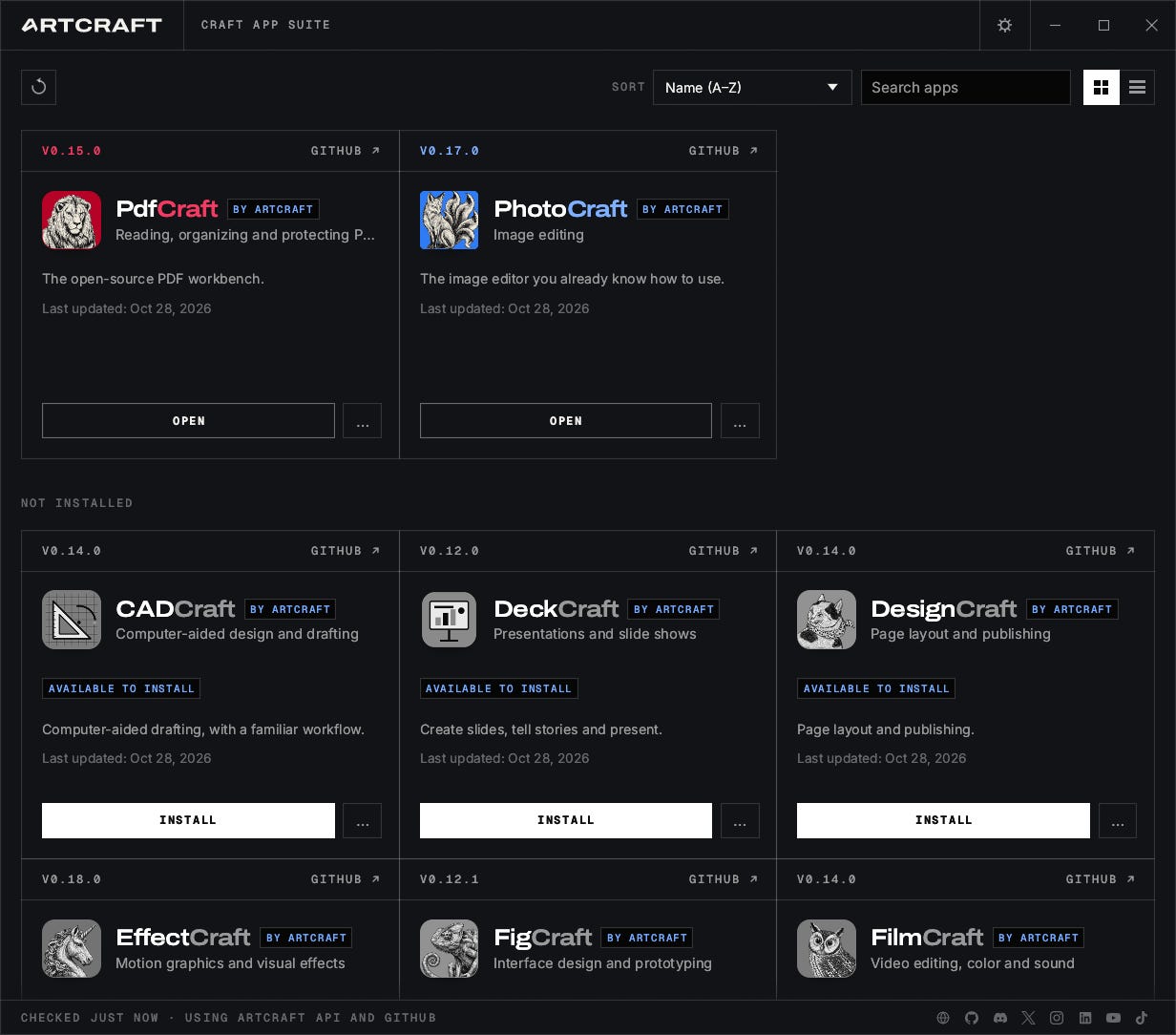
If you install the launcher (recommended), you get a dashboard that shows all ArtCraft apps. None is installed until you click on install (see image at top). For those you’ve installed, the dashboard will remind you when an update is available, at least in the Linux version.
2. This is the full suite so far.
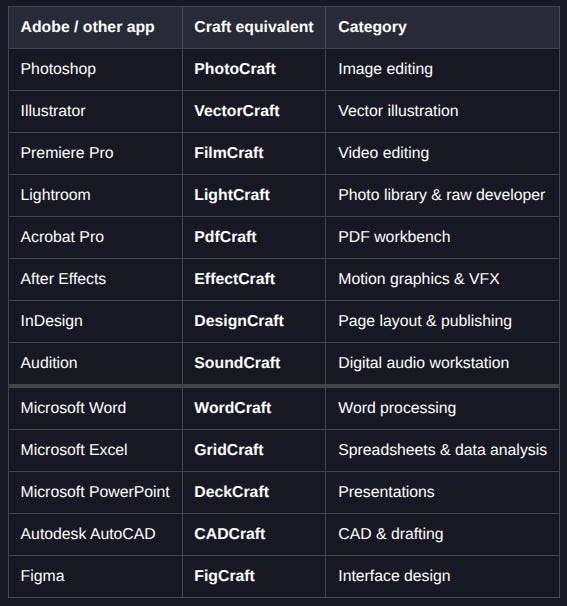
I’m personally starting with PdfCraft, the Acrobat clone, and will be testing GridCraft, the Excel clone, next. If you work with these apps yourself, feel free to post your experience. Note that because it’s early days, some feature will work better than others. That’s expected to change.
Critiques
To be fair, several writers have posted critiques of this project. Two are linked below:
• Attack of the Vibe Coded Photoshop Clones — Shokunin Studio, October 9
• The AI Photoshop clones — David Gerard, October 13
I’m posting the publication dates of these pieces since the project has evolved since then. These points are worth noting:
You don’t automatically get excellent software from AI coding models; a lot of testing and modifying is needed. That said, these programs are considered, in many cases, to be the best of their type.
As others have noted, commercial users of Photoshop, for example, have invested considerable time and money, not in just the product, but in a large ecosystem of plug-ins, add-ons and workflow organization. If these companies are cash-rich, they likely won’t switch from Adobe.
Smaller shops, however, and non-commercial users may be angry enough, or bit enough by the fees, that they’ll eagerly switch, especially if the learning curve isn’t great and the results are good. Stay tuned about this. The project started late in September. Let’s see how goes.
Unless you’re an occasional user, it’s important that these apps be maintained well into the future. Just saying.
More on the Full Story
If you have a few minutes, the full story is worth knowing. For that, see the video below. It was produced when the full suite was smaller, so keep that in mind. A transcript follows.
Transcript
He rebuilt Adobe in a week
A developer in Atlanta tried to cancel his Adobe subscription. They charged him a fee to leave, like a nightclub that charges you on the way out. So he rebuilt Adobe Photoshop, Illustrator, Premiere, Lightroom, After Effects, InDesign, and Acrobat: seven apps in about a week. It takes me longer than that to choose a font.
And he’s given them away for free. Adobe charges a professional $70 a month; over 10 years, that’s more than $8,000. He’s charging nothing. So here’s the question: can Adobe survive? I’m Pete. I make films, and on this channel I look at the industry I work in, warts and all. So let’s dive in.
If you’ve ever edited a photo, a video, or a poster, you’ve probably had a complicated relationship with Adobe. Love the tools, hate the bill. It is the gym membership of software. Today we’re going to look at the guy who just tried to break that relationship for good. Then, Adobe’s rap sheet, because it’s long. And then, what happens next? Lawsuit, or is the cat already out of the bag?
Who is Brandon Thomas?
His name is Brandon Thomas. He’s based in Atlanta, and he describes himself as an engineer and a filmmaker: about 15 years in software, about 10 of them writing a programming language called Rust.
This isn’t his first rodeo. He founded FakeYou, an app that does AI celebrity voices, then an AI film startup called Storyteller, which has now become ArtCraft. So this is the man who taught computers to do impersonations, and now he’s doing an impersonation of Adobe. And why did he do this? In his words, he’d been hit by Adobe’s dark-pattern cancellation fee more than once.
The ridiculous timeline
Here’s the timeline, and it’s ridiculous. On the 30th of September, the first line of code. On the 2nd of October, the first release of Photocraft. On the 7th, he posts it on Reddit and Hacker News, and the internet loses its collective mind, which, for the internet, is a very short trip.
The seven apps
Seven apps: Photocraft for Photoshop, Vectorcraft for Illustrator, Filmcraft for Premiere, Lightcraft for Lightroom, Effectcraft for After Effects, Designcraft for InDesign, and Printcraft, now renamed PDF Craft, for Acrobat. They run on Mac, Windows, and Linux, and even in a web browser. And they’re open source under the MIT and Apache licenses, which means anyone can download the code, change it, and share it forever.
How do you build 7 apps in a week?
AI. He built them with Claude, Anthropic’s AI. And full disclosure, I use Claude to help research this show, so take that how you like. I went through the public code history across seven apps. There are around 7,500 changes in about 10 days, and around 60% of them list Claude as the co-author. And people noticed: in a few days, Photocraft alone picked up nearly 40,000 stars on GitHub, which is basically the developer version of likes — developers don’t do hearts; too emotional. And it was copied or forked nearly 6,000 times. Then he said this: “Software is over.” He said, “We’ll replace Google search, build our own smartphones, and de-enshittify the entire tech world.” Big words.
Is it actually any good?
My honest answer: it’s impressive, but it isn’t Photoshop yet. One reviewer tested it on a weak laptop and found it fast. Layers, masks, smart objects, brushes, and it opens Photoshop files. But blend modes and filters didn’t match Photoshop. It ate 5 gigs of memory opening one file, which, to be fair, is also very Photoshop. And the verdict was: not for professionals. And he says it himself — he calls it a super early alpha. He first promised a 100% match with Adobe within a month; he’s since walked that back to months, not years.
What the headlines skipped
And a couple of footnotes the headlines skipped. He’s not exactly a lone genius in a bedroom. He comes out of a funded startup with a small team, and dozens of volunteers are now adding code. “Small team in an office” just doesn’t make as good a headline. And free isn’t quite free. The apps cost nothing; the company makes its money selling AI image and video credits and cloud storage on top. Oh, and he’s already started on PowerPoint, Excel, AutoCAD, and Pro Tools. He’s not coming for Adobe; he’s coming for everyone.
The weird bit: Adobe’s money
Now, here’s the weird bit. On paper, Adobe has never been richer. In its last quarter, Adobe made a record $6.7 billion. It says more than a billion people use its products every month. But the people who own Adobe shares are terrified. In November 2021, the stock was worth about $680 a share; last week, around $240. That’s roughly 65% gone. Goldman Sachs put a rare sell rating on it — Goldman saying sell is like your mom telling you your hair’s bad; they don’t do it lightly. The amount of new subscription business it’s adding fell by about a third. And the man who’s run Adobe for 19 years is stepping down in December. So the money’s still coming in, but the market thinks the party’s ending. And honestly, Adobe has spent a long time making itself very easy to leave the party from.
Adobe’s greatest hits
Let’s go through Adobe’s greatest hits. Get comfortable; it’s a double album. In 2013, Adobe stopped selling its software outright. Before that, the whole Master Collection was a one-off $25,000, and you owned it. Now you rent it forever, like a flat — except the landlord can put the rent up whenever he likes, and he keeps doing it. Tens of thousands signed a petition against it, and Adobe did it anyway. The plan started at $50 a month; it’s now $70, or $105 if you pay month to month.
Also in 2013, hackers stole the details of 38 million Adobe users and the source code for Photoshop. 38 million — that’s nearly the population of Canada.
In 2019, Adobe pulled older versions of its apps and warned people still using them that they may face potential claims of infringement — using software you paid for. Imagine Ford ringing you up to say driving your old car might get you sued. That same year, US sanctions: Adobe announced it would shut down every account in Venezuela. Refunds only came after a severe backlash.
In 2022, a licensing deal changed overnight. Pantone colors in people’s files turned black unless you paid for another subscription. Fifty Shades of Pay.
The cancellation fee
And then the big one: the cancellation fee. The thing that made Brandon build this. Sign up for the popular annual plan, paid monthly, and try to leave early, and you could be charged a fee of half of what’s left on your year’s subscription. The Hotel California had better exit terms. The US government sued Adobe over it in 2024, alleging the fee was buried in fine print and that cancelling was made deliberately hard — and even named two executives personally. This March, Adobe agreed to a $150 million settlement: $75 million in penalties, $75 million in free services. Adobe denies doing anything wrong. And in the UK, the competition watchdog has opened its own investigation.
The terms of use and Firefly
In 2024, new terms popped up saying Adobe may access your content through both automated and manual methods. Creators panicked that their work was training AI. Adobe rewrote the terms and promised it wouldn’t. Pinky promise. Meanwhile, it sells its own AI, Firefly, as the ethical one. Then Bloomberg reported that some of its training images were made by Midjourney, that stock contributors couldn’t opt out, and that the estate of Ansel Adams told Adobe publicly, “You are officially on our last nerve,” which is not a sentence any company wants to get from a photographer’s estate.
If you can’t beat them, buy them
And when Figma got too good, Adobe tried to buy it — the classic “if you can’t beat them, buy them.” Figma for $20 billion. Regulators blocked it, and Adobe had to pay Figma a billion dollars as a breakup fee.
The competition got good
And while all that was going on, the competition got good. Canva has over 260 million users, and last year it made the Affinity apps completely free. DaVinci Resolve has had a free version for years — and full disclosure again, this video was edited in Resolve, not Premiere. Even Adobe seems to know. On its last earnings call, the boss said he was glad they had deferred pricing actions in favor of user growth. The translation in plain English: we can’t keep putting the prices up.
Can Adobe just sue?
So what happens now? Can Adobe just sue?
On copyright, history isn’t on Adobe’s side. In 1995, a US court said a software menu structure is a method of operation, so you can’t copyright it. Apple tried to own the look and feel of a desktop and lost. And in 2021, the Supreme Court sided with Google against Oracle over copying how software talks to other software.
Courts have also ruled that taking apart a product to build a compatible one can be fair use. Adobe even publishes specifications for the Photoshop file format. And Brandon says this is a clean-room rebuild — no Adobe code.
There are already free Photoshop lookalikes: GIMP has been around since 1996, and Photopea was built by one developer and runs in your browser. As far as I can find, Adobe has never taken any of them to court.
But there are pressure points. Reviewers say some of these apps look almost identical to Adobe’s, which could invite a trade dress claim — that’s legal speak for copying the look of a product. Adobe’s names turn up in the project tags, and Adobe owns thousands of patents. I’m not a lawyer; I have watched every series of Suits, which I’m told doesn’t count. But that’s where the experts point.
Has a giant ever won?
Has a giant ever stamped out an open-source project? Nintendo did. It went after a Switch emulator called Yuzu, which got a $2.4 million settlement and had over 8,500 copies taken off GitHub. But that case was about breaking Nintendo’s encryption so people could play pirated games. A free photo editor written from scratch is a very different fight. And when the music industry got the YouTube downloader youtube-dl pulled from GitHub, it was pulled back within a month. Years ago, when Hollywood tried to ban the code that cracked DVDs, people printed it on t-shirts. Here’s the thing: the MIT and Apache licenses cannot be taken back for copies already out there. Photocraft has been copied nearly 6,000 times in a few days, on laptops all over the world.
Four ways this plays out
So let’s play it out. Scenario one, the most likely: Adobe ignores it, like it ignored GIMP and Photopea, says nothing, and hopes it fizzles out. Scenario two: a lawyer’s letter — change your icons, change your layout. That’s annoying, but the code survives. Scenario three: Adobe goes nuclear with patents. And then the company that just paid $150 million over cancellation fees is suing the guy who built this because of a cancellation fee. That’s not a lawsuit; that’s a free advert for ArtCraft. Scenario four: Adobe competes — cheaper plans, free tiers, easier cancelling. It’s already moving that way; its free users jumped 70% last year. So which one do you reckon? 1, 2, 3, or 4? Let me know in the comments.
The real story
But here’s what I think the real story is, and it isn’t ArtCraft. It’s the recipe. If a small team and an AI can build rough versions of seven apps in 10 days, someone else will do it next week and the week after. Even if Adobe shut ArtCraft down tomorrow, it wouldn’t matter. The cat isn’t just out of the bag — it’s teaching other cats how to open bags.
So, can Adobe survive?
Can Adobe survive as a company? Probably yes. Studios and agencies do not switch tools overnight. They’ve got plugins, pipelines, training, and decades of files. And ArtCraft right now is an alpha. But can Adobe survive as the company it’s been — charging rent forever, raising the price, and making it hard to leave? I don’t think so. When the competition can rebuild your product in a week and give it away, you can’t win by trapping people. You have to be the one they choose anyway.
Try it yourself
If you want to try these apps, there’s a link in the description. Go for it. But a few things: download them only from the official project page. This is AI-written alpha software, so don’t trust it with a client deadline yet. And keep backups. And if you are paying Adobe, check what kind of plan you’re on before you cancel. Now you know why.
And I want to know: would you switch, or is Adobe staying on your machine no matter what? Let me know in the comments. I’m Pete. Thanks for watching. Every source is in the description — check them. Don’t just trust me either. Have a good one. Catch you in the next one.