


I’ve been a fan of Ian Welsh and his writing for a very long time, going back to the glorious days of FireDogLake, when we thought we could confront Bush and win. His writing is good, he’s almost always right, and his on-the-nose style seems to cut through a lot of issues that defy simplicity.
With his permission, I’m going to repeat some posts of his for our Friday treats. His home page is www.ianwelsh.net. There are two that I have in mind to offer you.
One is on democracy and the West, a discussion we started with Alan Grayson’s last piece. I’ll save Ian’s comments on that until I’ve had my say, likely next week.
The second is below. It’s clear that war has just changed in a world-historical way, the way war changed when heavily armored knights were first introduced, shifting warfare from infantry strength — think Roman legionnaires — to the earliest battle tanks, with steel that was nearly impenetrable, stirrups for horse control, and the speed of cavalry assault.
We’ve seen generational changes since then. The latest is happening now, this year, this month. Drones are evolving faster than defenses against them. Nothing is safe, not in war, not in personal life.
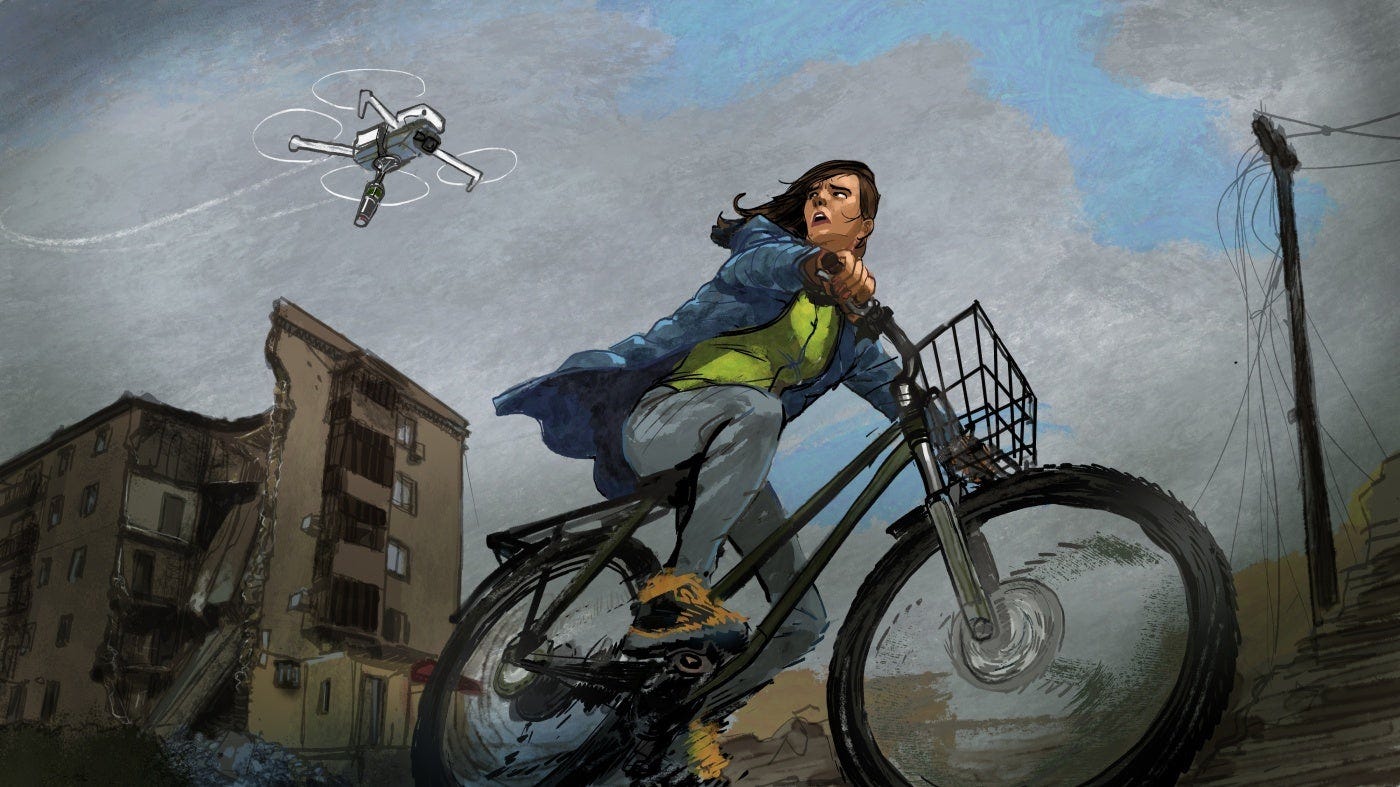
Needless to say, the whole U.S. military is now obsolete, and not just because it’s designed to maximize grift at the expense of production. Thanks to this war, all of the rest of the world sees all of its flaws. Our death grip on Latin America will shortly fail, and the homeland is target rich. It’s a new world.
Ian Welsh on these changes below.
Hypocrisy, Ansar-Allah, and the Military Revolution
By Ian Welsh
There have been a lot of condemnations of Ansar-Allah for hitting airports in Saudi Arabia. (They have hit every major airport except those in Mecca and Medina, multiple times and civilians have been killed.) I think a reminder is in order.
First, that this new war started when the Sauds hit Sana’a airport, but also:
The Saudi-Emirati coalition conducted more than 227 airstrikes on Sana’a Airport between March 26, 2015, and February 2022. (The airstrikes are documented in the United Nations)
2015: 67 airstrikes
2016: 62 airstrikes
2017: 7 airstrikes
2018: 47 airstrikes
2019: 7 airstrikes
2020: 15 airstrikes
2021: 12 airstrikes
2022: 10 airstrikes
Hundreds of thousands of Yemeni were killed by the Saudi/US blockade of food. The Sauds regularly hit hospitals, weddings, funerals — all the usual. They might as well be Israelis.
So I don’t want to hear crocodile tears now. The airports that are being hit are, unlike Sana’a during the siege, military targets. The Houthis have no airforce.
In addition to airports Ansar-Allah has been hitting refineries, pipelines and other oil infrastructure, essentially at will. The Sauds CANNOT protect their infrastructure. It is impossible.
This is a military revolution. Defense against missiles and drones is very hard, even Russia can’t stop constant attacks on their oil infrastructure, and they still have a decent stock of interceptor missiles. The Sauds are basically out, because America’s stocks are terminally low and Saudi Arabia is low on the priority list for what few there are (Israel gets first pick, then America.)
But even when there are lots of interceptors, drones and missiles are hard to stop, and the new offensive weapons are easier to make and cheaper than the defensive ones. This is especially the case for drones, but is also true for many missiles. In such a case, the strategy is to just to run the defenders out of missiles or overwhelm their launchers with huge strikes.
Over 10 years ago I wrote that drones would be a weapon [of] the weak. This is half true, but it’s true enough, and it’s now been proved over the board.
Understand clearly that this IS a revolution in military affairs, and that it means that any nation which is serious and decent sized can create a missile and drone deterrent that is very hard to stop. If they have a lot of mountainous terrain, even better, but Ukraine is almost entire flat land.
Right now the US is still able to bully Latin American countries, but its clear that it’s lost the ability project power significantly beyond the Americas. The Iranians have picked up strikes against tankers, and it’s clear that the previous slow pace was a decision, and the decision has changed [link to tweet].
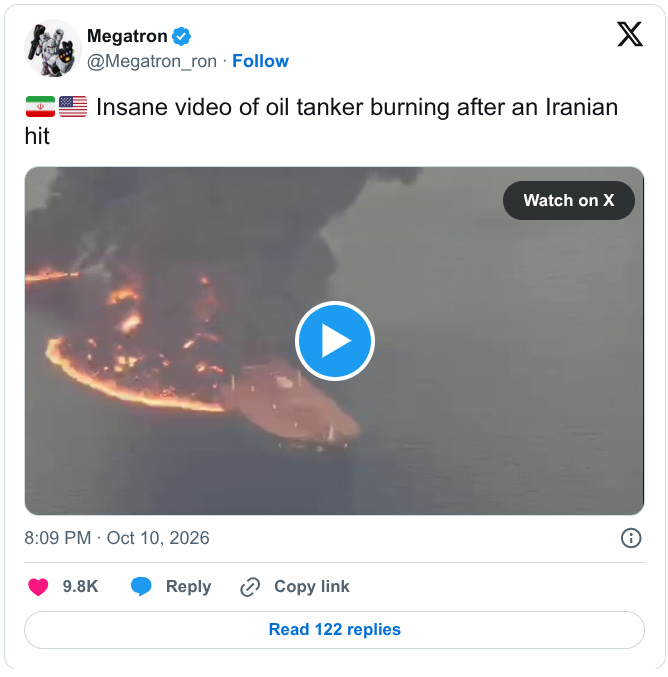
During the initial part of the war they effectively destroyed all US bases in the Middle East, including radars. It would take tens of billions to rebuild them, but since they can’t be defended (the US had plenty of interceptors at the time) that’s pointless. Odds are that most of the permanent US military presence in the Middle East will never return.
It is impossible to overstate just how much the calculus of force has changed: the US can no longer simply sit aircraft carriers off any prepared country’s coast and bomb the hell out of them.
Likewise this makes building up troops for ground operations very difficult. Think about trying to invade Iran. Where would you stage the troops that Iran can’t hit even as you’re trying to bring them in? There will be no major invasion of Iran, because it’s straight up impossible. In the Gulf War the Americans spent months building up forces nearby, that can’t happen any more.
Now Iran and Russia and China and Ansar-Allah were early adopters of this technology, and there are still lots of countries which have no significant drone or missile forces, but only complete incompetents haven’t noticed how effective they are, and you can be sure the technology will spread. If Ansar-Allah, in the most impoverished country in the world, can build drones and missiles (with some Iranian help) and if Iran, the most sanctioned country in the world could do so, there are few countries which couldn’t do the same if they really wanted to, and there are plenty of helpers available for them: China, Russia, Iran, even Ansar-Allah.
So this military revolution will spread, and as it does, the ability of the US to project power will be radically reduced. Further, in time, the tech for long-range missiles capable of striking the US will be developed and spread, and the US will no longer be able to go to war and think “but they can’t hit the homeland.”
All of this will come to be. It cannot be stopped, only slowed. And with Chinese sanctions on the US and Japan crippling their war industries, plus the US’s pathetic financialized military-industrial complex being ridiculously expensive and slow to manufacture anything, the US will not even be able to keep up.
Plus, a lot of countries are target poor. The US and its allies aren’t. One of the reasons Ansar-Allah is going hog wild hitting Saudi infrastructure is that after over a decade of being bombed to hell there isn’t much for them to lose. Their missiles hit targets which matter, while the Sauds mostly are reduced to terror bombing, which won’t stop the Houthis any more than it did the North Vietnamese.
The world is changing, things are happening, and the world order is changing completely.
Always need to remember that history did not start in 2026, or 2020, and the past is not even past. The Saudis took over Jizan, Asir, and Najran (disputed teritory north of current Yemen) in the 1934 Yemen-Saudi war, with British help, part of Saudi Arabia unifying itself.
It's interesting how these analysis, by many authors, seem to keep forgetting about North Korea. Not an early adopter on drones, but certainly missles. Iran definitely benefited by their quiet relationship on missle development, not to mention their technical assistance in mining operations to build underground fortresses.