
How Hubris Created an 'Invincible' Military
You go to war with the army your contractors give you

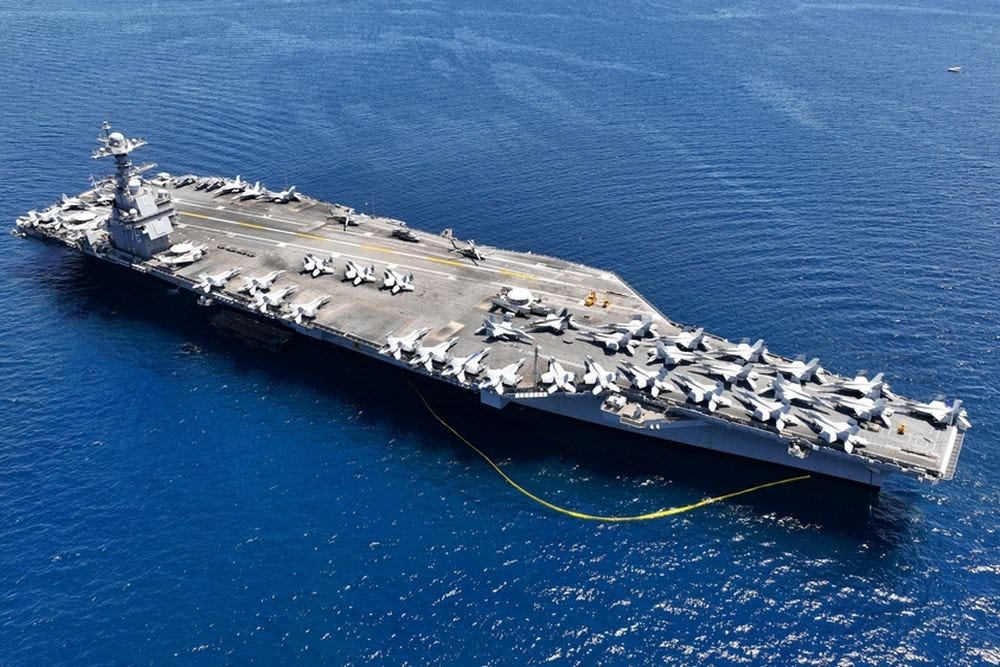
“In the exercise, the Red Team [Iranians] sank 16 Blue Team [American] ships: one aircraft carrier, ten cruisers, and five amphibious ships. In the real world, this would have equated to over 20,000 American military deaths.”
—Results on day 1 of the Millennial Challenge 2002 Pentagon exercise
“You go to war with the army your contractors give you.”
—Yours truly
More in our series of short takes and analysis of that ongoing American disaster, Israel’s War on Iran. This relevant call-back to 2002 comes via Twitterer Patricia Marins, a writer I’ve come to trust and author of one of the feeds in my curated Twitter War List. The information is well sourced (Washington Post and others), and well worth your time. It was first published here and reprinted in full below.
The tale’s bottom line rings a bell I’ve promoted before, that the U.S. military is so impossibly corrupted — a corruption born of hubris and Fantasyland thoughts — that it thinks it can substitute theft for effectiveness and suffer no consequences.
Or, as I earlier wrote:
This is what you get when your military supply chain is driven by profit and fraud (witness the F-35) instead of effectiveness. You go to war with the army your contractors give you.

Postol’s information is stunning. According to him, the corruption goes back to the 1990s.
The story below is about what our generals and admirals have done with their trillions — made themselves rich and made the country defenseless. This tale is valid today and a warning to all.
A Simulation That Tells Us a Lot
By Patricia Marins
I want to share an exercise from 2002 that has a lot to do with the current war, but also shows how astute commanders didn’t get the recognition they deserved.
Today, Iran doesn’t operate long or medium-range radars; it keeps almost all its equipment hidden inside mountains, including its planes, while deploying missiles, drones, and a asymmetric naval force.
This is a war the U.S. doesn’t know how to fight. Let me tell you a story, follow along:
The Millennium Challenge 2002 (MC02) took place from July 24 to August 15, 2002, under the U.S. Joint Forces Command. Planned over two full years, it simulated a hypothetical 2007 scenario where the U.S. invaded a Middle Eastern country, clearly inspired by Iran or Iraq.
The scale was massive: it cost $250 million and involved 13,500 personnel across 17 simulation sites and nine live locations. At the time, it was the largest and most expensive exercise in American history, designed to test the ‘network-centric’ warfare doctrine, featuring high-tech electronic surveillance and integrated command.
Then came the twist: the opposing force, the ‘Red Team’ representing a simulated Iran, was led by retired Marine Corps Lieutenant General Paul K. Van Riper, a [retired] three-star general known for his unconventional tactics and for being ‘devious’ — shrewd and unpredictable. He was chosen specifically for that reason: to provide a realistic challenge.
Van Riper did not disappoint. To bypass advanced U.S. electronic surveillance, he used ‘old-school’ asymmetric methods: motorcycle messengers for communication and World War II-style light signals, completely avoiding radars and digital systems.
This neutralized the American command and control system, which relied heavily on cutting-edge technology.
After receiving an ultimatum from the ‘Blue Team’ (the simulated U.S.) demanding surrender within 24 hours, Van Riper didn’t wait: he launched a devastating preemptive strike. In just 5 to 10 minutes, he used a massive salvo of cruise missiles combined with a fleet of small boats, including suicide attacks.
The result? The Red Team sank 16 Blue Team ships: one aircraft carrier, ten cruisers, and five amphibious ships.
In the real world, this would have equated to over 20,000 American military deaths, a total shock that paralyzed the exercise on the spot.
But here is the part where you’ll understand the mistakes the U.S. is making today in fighting an asymmetric war with Iran: the exercise was abruptly halted, the sunken ships were ‘refloated’ as if nothing had happened, and the simulation was restarted with rigged rules.
The Blue Team was given every advantage, and the Red Team was forced to follow a pre-written script with no freedom.
Van Riper was forbidden from using his clever tactics: he was ordered to turn on anti-aircraft radars just so they could be destroyed, told not to shoot at 82nd Airborne aircraft or CV-22s, and even forced to reveal his unit positions. It was essentially a staged script to guarantee an American ‘victory.’ Outraged, the general resigned [from the exercise] in protest, calling the whole thing ‘propaganda’ and ‘scripted.’” [Riper had already retired from active duty at the time of the exercise.]
Van Riper would be an ideal advisor for the situation in Hormuz, a situation for which I don’t see even the slightest military solution.
Yours truly: If you’ve read this far, thanks. I just want add, if Trump sends Marines to Kharg Island, there’s a Tennyson poem they might want to read before landing — “The Charge of the Light Brigade”.
Cannon to right of them,
Cannon to left of them,
Cannon in front of them
   Volleyed and thundered;
Stormed at with shot and shell,
Boldly they rode and well,
Into the jaws of Death,
Into the mouth of hell
   Rode the six hundred.
Our Marines may suffer this fate — “droned at with shot and shell” — all because generals grew fat not serving their country.
In some recent readings Inam coming to understand what terrible shape our Navy is in. Hardly fit for purpose. Trump’s begging from Europe is because we have no littoral fleet despite 20 years of spending. The Europeans have tons of these small ships. Italy and Japan could them we can’t manage. Our maintenance capabilities appear poor and we rely on Japan and Korea to do an acceptable job. The country is sounding distressingly like a hollowed out power. I hope not but it seems we have wasted money with nothing to show for it.
Kharg Island is at the far end of the Gulf, not far from Kuwait. Any assault force venturing that far would end up like the French Army at Sedan in 1870 -- "Nous sommes dans un pot de chambre, et nous y serons emmerdés," in the immortal words of General Ducrot.
Qeshm would make more sense since it's right next to the Strait of Hormuz. Still, it's putting a lot of Marines in a very precarious situation. Close air support would be an absolute essential and achieving that would probably involve bringing carriers much closer to Iran. Millenium Challenge anyone?